
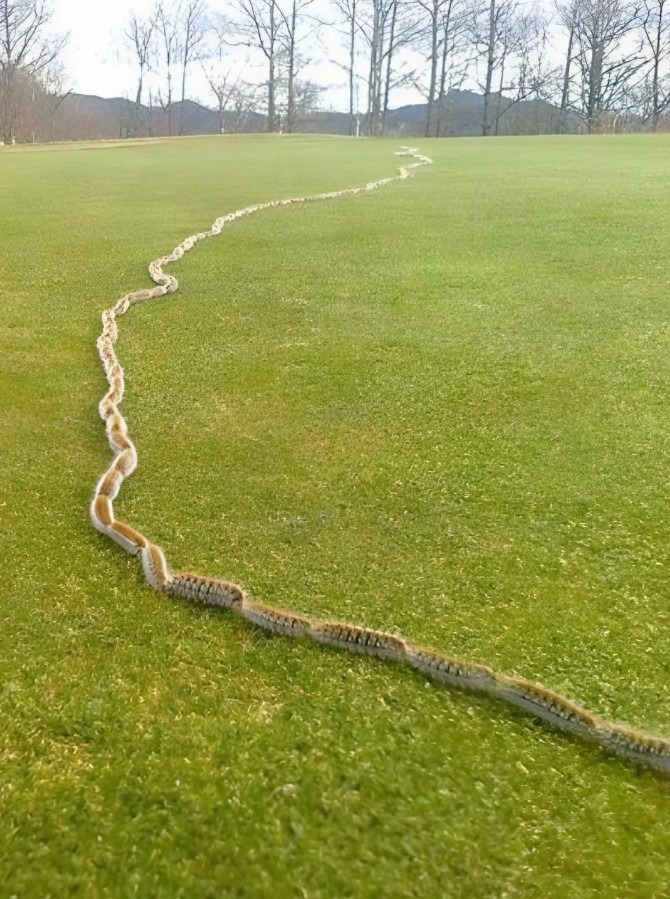
You know that moment?
When your brain sees something long, dark, and winding through the grass—
And instantly whispers:
“Snake.”
That’s exactly what happened to me yesterday at noon.
I was stepping into my garden, coffee in hand, ready to enjoy the quiet morning sun…
Then I saw it.
A twisting, coiling shape snaking across the lawn.
Still. Silent. Too perfect to be natural.
My first thought?
👉 “Who left a rope here?”
My second?
😨 “Oh no. That’s not a rope. That’s alive.”
Heart pounding, I grabbed my phone.
Took a shaky photo.
Took a step closer.
And then—
I screamed.
Because it wasn’t a snake.
It wasn’t a rope.
It was something far stranger.
🐛 What I Actually Saw:
🐛 What I Actually Saw: A Living Caterpillar Chain
As I leaned in—breath held—the “rope” began to move.
Not slithering like a snake.
But pulsing. Crawling.
A slow, undulating wave of tiny legs and soft bodies moving in perfect unison.
I counted them later.
👉 150 caterpillars.
Maybe more.
They were marching in a tight, single-file column, each one following the one ahead, forming a living chain over two feet long.
No gaps.
No stragglers.
Just a silent, synchronized procession across my yard.
It looked like nature had gone viral.
🔍 So… What Was This? (Spoiler: It’s Real — And Called a “Procession”)
What I witnessed is called a caterpillar procession—a behavior seen in certain species, most famously:
🐾 The Pine Processionary Caterpillar (Thaumetopoea pityocampa)
Found in Europe, parts of Asia, and North Africa
Lives in pine or cedar trees
Travels in nose-to-tail lines up to 300+ strong
Each caterpillar follows the silk trail laid by the one before it
But even in the U.S., native species like tent caterpillars and fall webworms do this too—especially when:
Leaving their nest to find a place to pupate (turn into moths)
Following pheromone trails laid by leaders
Moving as a group for safety in numbers
👉 They’re not lost.
They’re on a mission.
❓ Why Do They Move Like This?
It’s pure survival instinct.
Here’s how it works:
Next Page
Pages: 1 2
